Tamilnadu Govt Stops Issuing Solvency Certificates | Key Update 2025
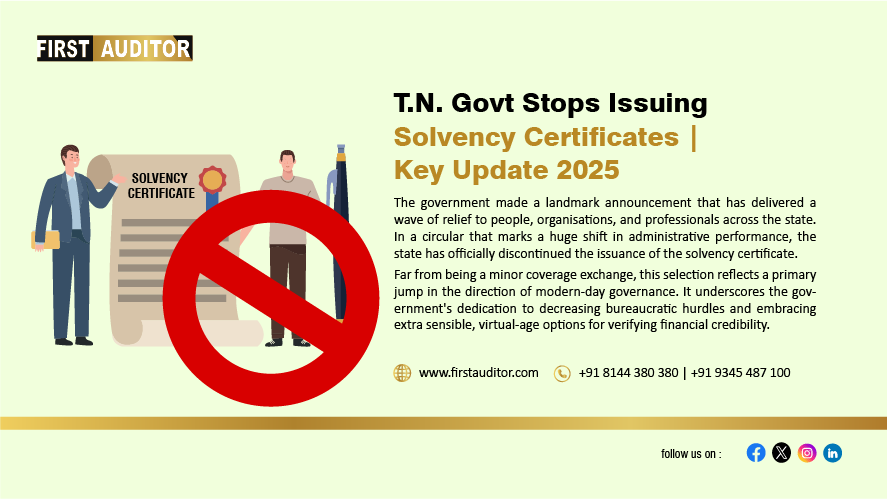
The government made a landmark announcement that has delivered a wave of relief to people, organisations, and professionals across the state. In a circular that marks a huge shift in administrative performance, the state has officially discontinued the issuance of the solvency certificate.
Far from being a minor coverage exchange, this selection reflects a primary jump in the direction of modern-day governance. It underscores the government's dedication to decreasing bureaucratic hurdles and embracing extra sensible, virtual-age options for verifying financial credibility.
What Was the Solvency Certificate, and Why Did It Matter?
A solvency certificate becomes a government-issued file used to certify a person’s or entity’s financial balance and capacity to fulfil economic responsibilities. It turned into often required for:
- Applying for tenders and authorities contracts
- Securing high-interest loans
- Visa programs
- Legal and monetary transactions
To get one, candidates needed to navigate a complex system via the e-seva portal. They have been required to submit exhaustive information, including land possession (in acres), present-day assets valuation, percentage of ownership, and the amount for which the certificates became needed. Once submitted, the software was scrutinised by sales officers from the Revenue Inspector up to the Tahsildar, typically taking over 15 days—if not more.
Why the Solvency Certificate Was Phased Out
The concept in the back of the solvency certificate was rooted in warning—to make certain that the simplest financially sound entities ought to tackle extensive duties. But in practice, it has become a bureaucratic burden. An Empowered Committee was formed to evaluate its effectiveness, and its findings brought about this much-needed reform.
Key Issues Identified:
One-Time Validity
- Applicants needed to undergo the entire process every time a brand new certificates become needed—even though their economic reputation hadn’t changed.
Excessive Documentation
- In addition to land info, applicants had to procure difficult-to-get access to documents like liability quantity and mortgage certificates.
Discretionary Delays
- Despite the legitimate 15-day processing time, the actual issuance frequently changed into not on time because of subjective decision-making by officials.
In essence, the certificates added complexity without providing real cost, especially when more credible and up-to-date financial documents are already broadly commonplace.
The Smarter Alternative: Reliable Financial Proofs Already in Use
One of the most compelling arguments made by using the Empowered Committee was that several reliable and verifiable monetary files already exist—and they do a better job than the solvency certificates ever did.
Here are some of the modern alternatives now preferred throughout sectors:
Income Tax Returns & Clearance Certificates
- Offer an obvious and authorities-verified document of income and tax compliance.
Audited Balance Sheets & Auditor’s Certificates
- Provide an impartial overview of a corporation’s or individual’s economic role, assets, and liabilities.
GST and VAT Returns
- Indicate energetic commercial enterprise operations and compliance with tax rules.
Bank Guarantees & Statements
- Directly show economic power and cash flow, certified by using economic establishments.
Credit Line Certificates & Net Worth Statements
- Accurately reflect one’s ability to elevate price range or repay duties.
PAN Card & Collateral Documents
- Serve as identity and asset possession proofs, relied on throughout prison and monetary institutions.
These files are not the most effective, extra contemporary, and applicable; however, they also offer better duty and traceability, making them a step ahead of the outdated solvency certificate.
What This Decision Means for Tamil Nadu
For Citizens and Business Owners
- This is a welcome comfort. It gets rid of the need to gather immoderate office work and make repeated visits to government offices. The result? Time, electricity, and fee savings.
For Government Departments
- Officials can now focus on more impactful administrative work, instead of spending time verifying solvency claims, which might be higher contemplated via current economic documents.
For Policy and Governance
- The decision displays a contemporary governance version—agile, responsive, and people-centred. It shows the state's willingness to conform by dropping previous structures and embracing transparency and efficiency.
A Step Toward Simplified, Transparent Governance
This reform isn't pretty much putting off a certificate—it’s about redefining how economic balance is confirmed in Tamil Nadu. It’s a sign that the authorities recognise the need for modernisation and are actively operating to make administrative techniques less complicated and more logical.
By shifting in the direction of documents which might be auditable, present-day, and institutionally tested, the authorities are promoting a more reliable and consumer-friendly documentation environment. It’s a selection that not only empowers citizens and organisations but also complements the credibility of economic assessments across the board.
Conclusion: A Progressive Move Worth Applauding
The Tamil Nadu authorities deserve credit for taking this forward-thinking step. It’s an administrative reform that, without delay, advantages humans, aligns with country-wide financial practices, and removes redundancy in government strategies.
Let’s hope this is just one of many such reforms aimed at simplifying life for residents, reducing administrative friction, and promoting digital governance.
Frequently Asked Questions
Applicants may now use bank guarantees or net worth certificates as proof.
Business bidders, students, and government contractors are mainly affected.
Yes, the discontinuation applies across all districts of Tamil Nadu.