


First Auditors platform is a technology-driven platform that offers specialized legal and financial advisory services in India.
Understand the key differences and the conversion process between Private Limited and Public Limited Companies.
A privately held firm for small businesses. In a private limited corporation, each member's responsibility is limited to the amount of shares that they each own. A private limited company's shares cannot be exchanged.
A business whose shares can be bought and sold by anybody and are traded on a stock exchange. A publicly held firm is another name for it. A public limited company is one that, as its name implies, sells firm shares to the broader public. A public limited company is one that offers firm shares to the general public and has limited liability, according to the Company's Act of 2013. Anyone can purchase shares of such a corporation through IPOs or stock market trading, respectively (Initial Public Offerings).
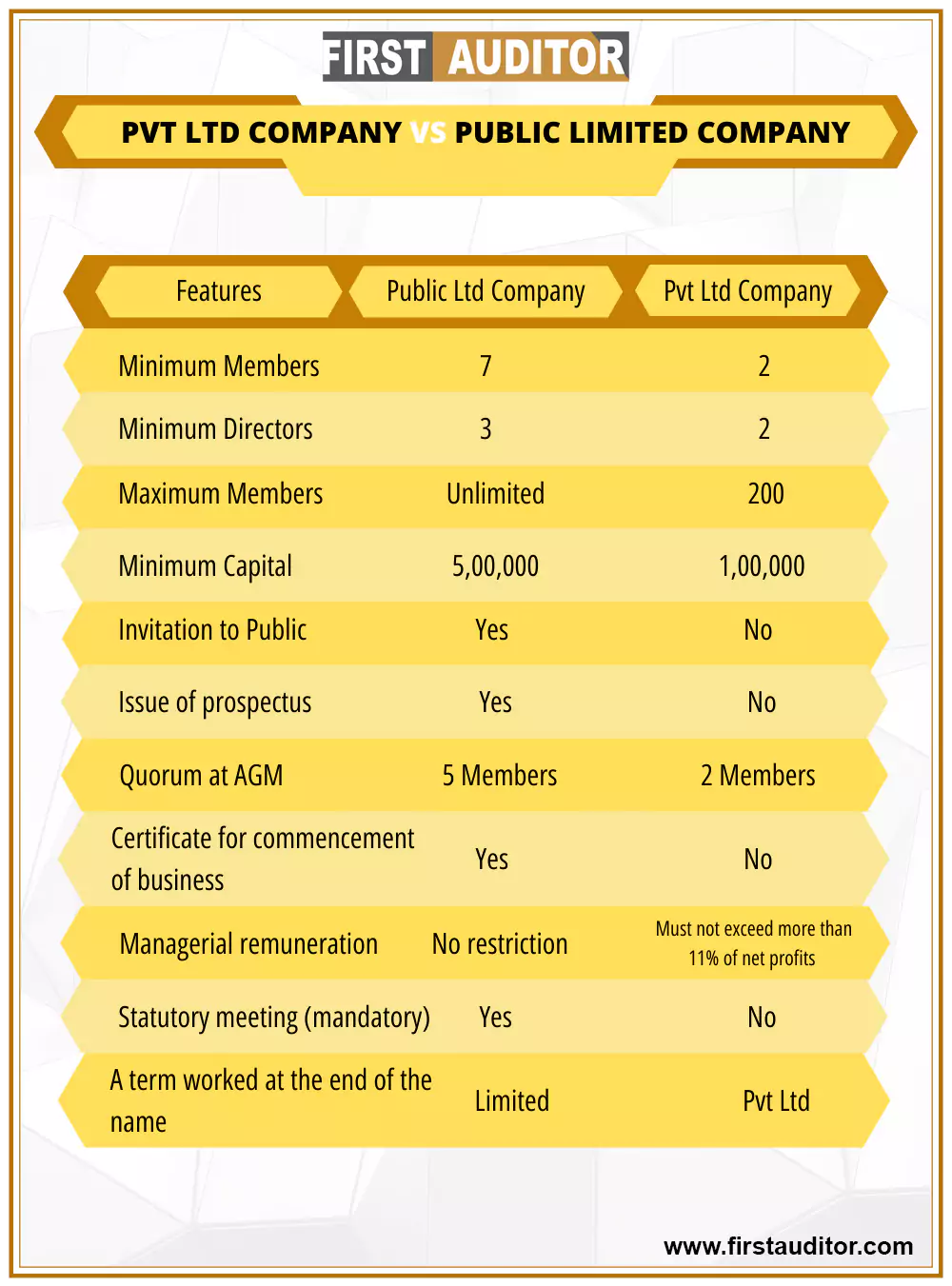
Businesses looking to raise capital through public offerings, expand operations, or enhance their market credibility can benefit from converting to a Public Limited Company.
To convert a Private Limited Company to a Public Limited Company, the following eligibility criteria must be met.
Converting to a public limited company offers several strategic advantages.
A public limited company's shareholders can easily transfer their shares. They only need to give the buyer the share certificate and file the share transfer form.
The public limited structure allows you to use shares to raise cash from the general public. All public limited businesses are permitted to offer fixed deposits, debentures, and convertible debentures.
Public limited businesses must make their audited statement of accounts public, notify regulatory agencies of any structural changes, and hold annual general meetings open to all shareholders. This builds trust.
Being a public company opens doors for mergers, acquisitions, and strategic partnerships, facilitating business growth and expansion.
The following documents are required for the conversion process:
Follow these steps for a smooth conversion from Private to Public Limited Company.
Call a board meeting and pass a resolution to initiate the conversion process. Approve the draft of the amended MOA and AOA.
Convene an Extraordinary General Meeting (EGM) and pass a special resolution for conversion with at least 75% shareholder approval.
File Form MGT-14 with the ROC within 30 days of passing the special resolution along with the required documents.
Amend the Memorandum and Articles of Association to reflect the new public company structure and regulations.
File Form INC-27 with the ROC for the conversion process and attach all necessary documents and forms.
Upon approval, the ROC issues a fresh Certificate of Incorporation as a Public Limited Company.
Once converted to a Public Limited Company, the status is valid as long as statutory compliances are met.
We manage every step, document, and filing with the ROC so you can focus on your business transition.
We verify your eligibility and ensure all requirements are met for a smooth conversion.
Help preparing and organizing all required documents and forms.
Guidance on board meetings and shareholder approvals for conversion.
Assistance in amending MOA and AOA to reflect the public company structure.
Complete filing of Form MGT-14 and INC-27 with the Registrar of Companies.
We respond to any queries or clarifications raised by the ROC.
Regular follow-up with ROC to ensure timely processing of your application.
Delivery of the new Certificate of Incorporation as a Public Limited Company.
Guidance on post-conversion compliance and record updates.
Talk to a First Auditor specialist today — get a clear fee quote and document checklist before you start.
Copyright © 2024 First Auditor,All Rights Reserved.