
WhatsApp Mail Us Call Us

Close the Pvt Ltd Company

We specialize in Close the Pvt Ltd Company Registration services to help your business meet compliance requirements and contribute to sustainable growth. Our services include the following:

Get Specialized Assistance

Overview

Close the Pvt Ltd Company — Introduction

A firm is wound up when all commercial activities are stopped, transactions are stopped, and all company assets are sold to other people or businesses in order to pay off any outstanding debts. When the company's obligations are paid off, the residual assets will be distributed to shareholders in proportion to their capital investments.

There are two methods that can be used to wind up the business. Mandatory winding up: A special resolution passed by the directors during the company's board meeting that requests a court intervention might be disregarded in favor of the compulsory winding up of a company being carried out by a tribunal or court order. Similar to this, if the company has engaged in any fraudulent or unlawful actions, it may be forced to wind up by any official person of the firm submitting a petition with a court or a tribunal.

Voluntarily dissolving: The Corporation needs a resolution from the directors in order to dispose off all of its assets or transfer its stock to another organization.
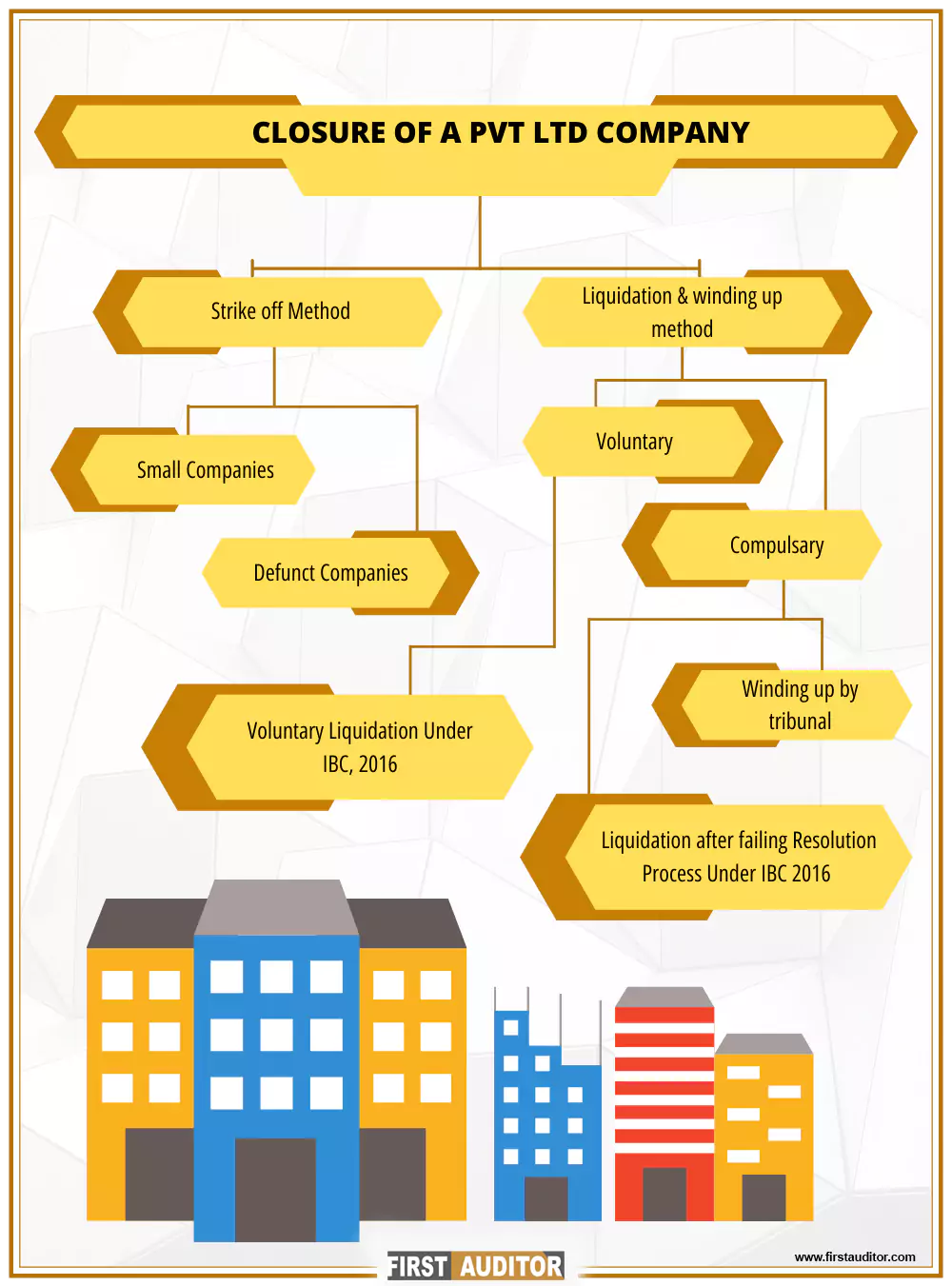
Close Private Limited Company Services
Who Needs This Service

Is Closing Your Private Limited Company the right choice?

Any company looking to wind up its operations, dissolve its legal entity, or cease business activities needs to follow the proper closure process.

  • Companies ceasing business operations
  • Businesses facing insolvency
  • Companies wanting to dissolve legally
  • Businesses restructuring
  • Companies merging with other entities
  • Any company wishing to close
Benefits

Advantages of Closing a Business

Closing a business properly provides several advantages for directors and shareholders.

  • After the Liquidation: After the liquidation procedure is complete, all directors and corporate officers are released from all debts and obligations to creditors
  • Avoiding Legal Action: If the resolution is approved willingly by the board of directors, they will ignore any legal action brought by the court or the tribunal and give the company's directors a platform to focus on other commercial prospects
  • Comparatively Low Cost: Because fees will be assessed on the sale of assets, the cost or costs associated with the liquidation process are modest
  • Cancellation of Leases: Any lease that a corporation or other entity had signed for a set period of time will be terminated, together with all of its terms and conditions, during the liquidation process
  • Advantages for Creditors: Following a protracted legal battle, creditors will gain from the liquidation process since they will be qualified for a default payment with regard to the proposal of credits given by all creditors
Documents Required

Documents Needed to Close a Private Limited Company

The following documents are required to close a private limited company:

Company Documents
  • PAN card for the business
  • Bank account closure certificate for the business
  • An indemnification bond, which the directors must notarize
Financial Documents
  • Newest financial statement for the company
  • Accounts that include all of the company's assets and obligations and have been reviewed by a Chartered Accountant (CA)
  • Proof that the resolution was approved by 3/4 of the board
ROC Documents
  • Application to have the corporate name removed
  • Form STK-2 (Strike off application)
  • Form GNL-2 (General purpose form)
Procedure

Step-by-Step Process to Close a Private Limited Company

The closure process follows a defined sequence of steps to legally dissolve the company.

01
Board Meeting

Convene Board Meeting

Call a board meeting to discuss and approve the proposal to close the company. Pass a board resolution authorizing the closure.

02
Shareholder Approval

Obtain Shareholder Consent

Obtain consent from 3/4th of the shareholders approving the closure of the company. File necessary resolutions and get them notarized.

03
Documentation

Prepare Closure Documents

Prepare all necessary documents including financial statements, indemnification bond, and bank account closure certificate.

04
ROC Filing

File with Registrar of Companies

File Form STK-2 (Strike off application) and Form GNL-2 with the Registrar of Companies. Submit all required documents and pay the applicable fees.

05
Approval

ROC Review & Dissolution

The Registrar of Companies reviews the application and, upon satisfaction, strikes off the company's name from the register. The company is officially dissolved.

Authority, Timeline & Fees

Where the application goes, and what it costs

Government Authority

Registrar of Companies (ROC), Ministry of Corporate Affairs (MCA), Government of India.

Estimated Processing Period

Typically 2 to 3 months from complete document submission, depending on ROC workload and compliance.

Certificate Issued

Dissolution certificate from ROC confirming the company is struck off from the register.

Fee Structure

Government filing fees based on the company's authorized capital. Professional fee quoted upfront by First Auditor.

ComponentPaid ToNature of charge
Form STK-2 Filing Fee Registrar of Companies Based on authorized capital
Form GNL-2 Filing Fee Registrar of Companies Based on authorized capital
Stamp Duty Government As per applicable rates
Professional fee First Auditor Quoted upfront, one-time

Government fees are prescribed by MCA. Our team quotes both components separately before you proceed, with nothing added later.

Common Reasons for Rejection

What causes ROC to reject a company closure application

  • Incomplete or incorrect form submission
  • Missing or invalid documents
  • Outstanding government fees not paid
  • Pending legal or regulatory compliance
  • Shareholder consent not properly obtained
  • Outstanding liabilities not settled
  • Indemnification bond not notarized
  • Company has pending tax or statutory dues
How First Auditor Assists

One team, from board meeting to ROC dissolution certificate

We manage every step, document, and filing with the ROC so you can focus on your business transition.

Document Check

We verify your eligibility and ensure all required documents are complete and valid.

Resolution Drafting

Assistance in drafting board and shareholder resolutions for company closure.

Meeting Support

Guidance on board meetings, shareholder consent, and compliance requirements.

ROC Filing

Complete filing of Form STK-2 and GNL-2 with the Registrar of Companies.

Query Handling

We respond to any queries or clarifications raised by the ROC.

Timely Follow-up

Regular follow-up with ROC to ensure timely processing of your application.

Documentation Support

Help preparing and organizing all required documents for the closure.

Bank Account Closure

Guidance on closing company bank accounts and obtaining closure certificates.

MCA Record Update

Ensuring the company's dissolution is reflected on the MCA portal.

Frequently Asked Questions

FAQ

The process involves obtaining shareholder consent, filing necessary forms with the Registrar of Companies, and settling all debts and liabilities before initiating the closure.

The closure process typically takes 2 to 3 months, depending on the specific circumstances and compliance with legal requirements.

Yes, there are fees for filing necessary forms and documentation with the Registrar of Companies, which can vary based on the company's capital and liabilities.

All assets must be sold or distributed to shareholders, and any outstanding liabilities must be settled before finalizing the closure.

Once a company is officially closed, it cannot be reopened. However, a new company can be formed under a different name if desired.

Voluntary winding up is initiated by the company's directors and shareholders, while compulsory winding up is ordered by a court or tribunal due to insolvency, fraud, or other legal reasons.

First Auditor provides end-to-end assistance for closing a company including document verification, resolution drafting, ROC filing, and post-closure compliance. We ensure error-free submission and timely dissolution.

Yes, a Chartered Accountant (CA) certificate is required to verify that all company assets and liabilities have been properly accounted for and settled before closure.
Close
Ready

Ready to Close Your Private Limited Company?

Talk to a First Auditor specialist today — get a clear fee quote and document checklist before you start.

Request a Callback
Disclaimer: This page is provided for general informational purposes only and does not constitute legal, tax, or professional advice. Filing requirements, forms, and timelines are prescribed by the Ministry of Corporate Affairs under the Companies Act, 2013 and are subject to change without notice. First Auditor is an independent professional services firm and is not affiliated with, or an agent of, any government department. Please consult our team or a qualified professional for advice specific to your situation before making any closure decision.
Startup

ISO Certifications

CDSCO Medical Devices

CDSCO Cosmetic

Invitro Diagnostic Device

Hiring Documents

Business Certification

Certification

Bureau of Indian Standards

Business Collabrations

Service & vendor

Business License

Drugs

EPR

Websites Policies
Trademark

Business Conversations

Changes in Pvt

Overview Of Annual Fillings

Changes in LLP