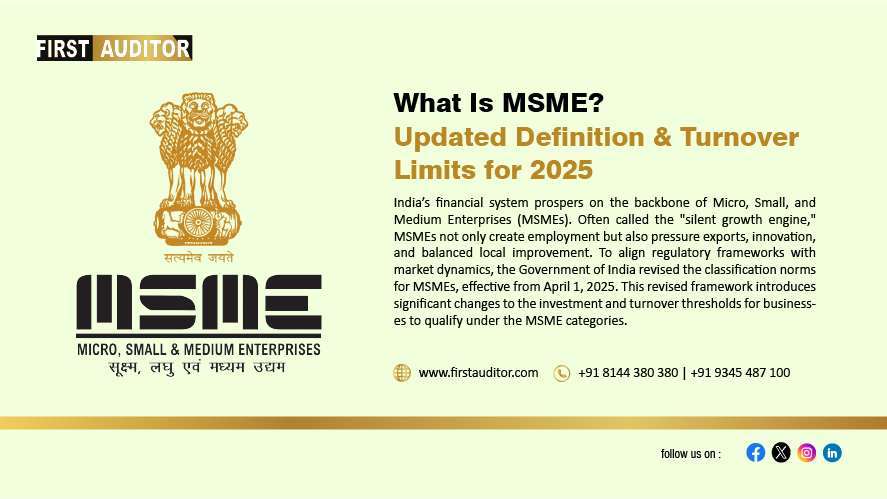
What Is MSME? Updated Definition & Turnover Limits for 2025
India’s financial system prospers on the backbone of Micro, Small, and Medium Enterprises (MSMEs). Often called the "silent growth engine," MSMEs not only create employment but also pressure exports, innovation, and balanced local improvement. To align regulatory frameworks with market dynamics, the Government of India revised the classification norms for MSMEs, effective from April 1, 2025. This revised framework introduces significant changes to the investment and turnover thresholds for businesses to qualify under the MSME categories.
In this article, we’ll provide an explanation for what the MSME manner is, the significance of the cutting-edge classification, and how the revised turnover and funding thresholds will affect organisations in 2025.
What is MSME?
MSME stands for Micro, Small, and Medium Enterprises. These companies shape the backbone of business development in India and contribute appreciably to GDP and exports. The type enables the authorities to formulate help regulations, economic resource schemes, and compliance necessities based on the corporation's size.
According to the MSME Development Act, 2006, MSMEs are categorised based on two predominant factors:
- Investment in Plant and Machinery or Equipment
- Annual Turnover
This twin criterion ensures a fair and balanced assessment for organisations engaged in each of the production and provider sectors.
Why MSME Classification Matters
A proper class of an organisation below the MSME reputation offers multiple benefits:
- Access to government schemes and subsidies
- Collateral-unfastened loans and credit ensure
- Ease of compliance with various legal guidelines
- Protection against non-timely payments
Eligibility for reduced charge loans and precedence lending
With revised limits in the vicinity from April 2025, extra companies now qualify as MSMEs, therefore gaining access to these benefits.
Revised MSME Classification in 2025
On March 21, 2025, the Ministry of Micro, Small and Medium Enterprises released Notification No. S.O. 1364(E), announcing revised category limits for MSMEs. These changes became effective from April 1, 2025.
Here is the up-to-date class primarily based on composite standards (Investment + Turnover):
Classification Criteria for MSMEs (2025):
Micro Enterprise:
- Investment in plant and machinery or equipment should not exceed ₹2.5 crore.
- Annual Turnover: Up to ₹10 Crore
Small Enterprise:
- Investment in Plant & Machinery/Equipment: Up to ₹25 Crore
- Annual Turnover: Up to ₹100 Crore
Medium Enterprise:
- Investment in Plant & Machinery/Equipment: Up to ₹125 Crore
- Annual Turnover: Up to ₹500 Crore
This category applies uniformly to production establishments and provider firms, ensuring equal treatment throughout sectors.
A Quick Comparison: Old vs New MSME Limits
Let’s understand the full-size shift made by the authorities by way of evaluating the 2020 and 2025 thresholds.
| Enterprise Type | Old Investment Limit (2020) | New Investment Limit (2025) | Old Turnover Limit (2020) | New Turnover Limit (2025) |
| Micro | ₹1 Crore | ₹2.5Crore | ₹5Crore | ₹10 Crore |
| Small | ₹10 Crore | ₹25 Crore | ₹50 Crore | ₹100 Crore |
| Medium | ₹50 Crore | ₹125 Crore | ₹250 Crore | ₹500 Crore |
This shift displays the government's aim to accommodate inflation, sectoral increase, and the evolving scale of organisations.
Composite Criteria Explained
The MSME category is primarily based on each investment and turnover, now not either-or. Here's how it works:
- If a company exceeds both the funding and turnover restrictions of its cutting-edge class, it will be upgraded to the subsequent class.
- A business enterprise will be downgraded only if both investment and turnover fall below the limits of a lower class.
- This guarantees accurate class and encourages growth at the same time, as it averts misuse of the MSME benefits.
Real-World Examples
ABC Textiles Pvt. Ltd.
- Investment: ₹20 Crore
- Turnover: ₹90 Crore
→ Falls under the Small Enterprise category.
XYZ IT Services
- Investment: ₹1.5Crore
- Turnover: ₹15 Crore
→ Classified as a Small Enterprise, because it exceeds the Micro turnover restriction.
Nano Manufacturing LLP
- Investment: ₹2 Crore
- Turnover: ₹9Crore
→ Eligible for Micro Enterprise class.
Benefits of MSME Registration in 2025
If your enterprise falls under the new thresholds, registering as an MSME can provide the following advantages:
1. Financial Support
- Access to collateral-free loans under the Credit Guarantee Scheme.
- Reduced hobby prices from public and private regional banks.
- Preference in government procurement under the Public Procurement Policy.
2. Tax and Compliance Benefits
- Exemption from Income Tax Audits for eligible MSMEs.
- Deferred charge of statutory dues like GST.
- Priority sector lending from banks and NBFCs.
3. Subsidies and Incentives
- Subsidy on patent registration and ISO certification.
- Reimbursement for exchange galleries and exhibitions.
- Concession on electricity payments and other utilities (kingdom-precise).
How to Register as an MSME in 2025
Registration is executed via the Udyam Portal (https://udyamregistration.Gov.In).
Requirements:
- Aadhaar of the owner or authorised signatory
- PAN and GSTIN
- Investment and turnover information (related through ITR and GST returns)
Steps:
- Visit the Udyam Registration Portal.
- Enter your Aadhaar and validate with OTP.
- Fill in commercial enterprise info.
- Generate your Udyam Registration Number and Certificate instantly.
Conclusion
The Government of India's revised MSME classification, effective from April 1, 2025, marks a significant milestone in promoting business-friendly reforms. By increasing the investment and turnover thresholds, more enterprises—especially those affected by inflation and expanding operations—can now access the wide array of MSME benefits.
Frequently Asked Questions
The Ministry of MSME defines the new limits via official notification, effective from April 2025.
Compare your investment and turnover against 2025 MSME criteria published by the ministry.
Investment and turnover thresholds were increased for all categories in 2025.