BIS CRS Certification for Optical Fingerprint Scanners
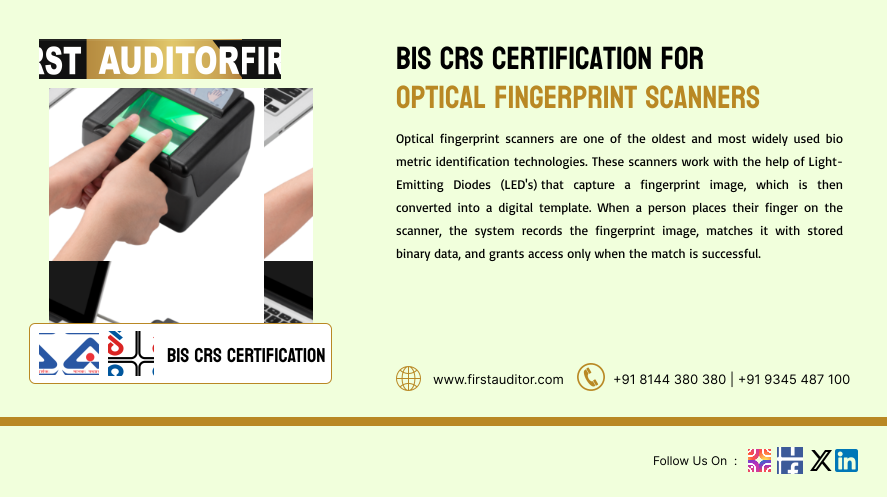
Optical fingerprint scanners are one of the oldest and most widely used biometric identification technologies. These scanners work with the help of Light-Emitting Diodes (LEDs) that capture a fingerprint image, which is then converted into a digital template. When a person places their finger on the scanner, the system records the fingerprint image, matches it with stored binary data, and grants access only when the match is successful. Known for being highly reliable and counterfeit-resistant, optical fingerprint scanners are extensively used in workplaces, government offices, and secure access control systems.
In line with safety and quality compliance, the Bureau of Indian Standards (BIS) made it mandatory on 23rd May 2018 for all manufacturers of optical fingerprint scanners to obtain BIS CRS Certification under IS 13252 (Part-1):2022. Without this certification, such products cannot be legally sold in the Indian market.
If you are a manufacturer or importer of fingerprint scanners and want to expand in India, it is essential to understand the BIS registration process, rules, and required documentation. Businesses in regions like Chennai and across Tamil Nadu are increasingly applying for BIS CRS certification to ensure market access and consumer trust.
What is BIS Registration?
BIS registration is a process where the Bureau of Indian Standards certifies that a product meets defined Indian quality and safety standards. For optical fingerprint scanners, BIS registration falls under the Compulsory Registration Scheme (CRS).
In simple terms, BIS registration ensures that products being sold in India are tested for safety, reliability, and quality before reaching consumers. This helps protect buyers from low-quality or harmful products while giving manufacturers credibility and market acceptance.
An Overview of BIS CRS Scheme
The Compulsory Registration Scheme (CRS) was introduced in 2012 by the Ministry of Electronics and Information Technology (MeitY) in collaboration with BIS. The scheme covers various electronic and IT products that must undergo testing and registration before being sold in India.
For optical fingerprint scanners, BIS CRS certification under IS 13252 (Part 1):2022 ensures compliance with safety standards and confirms that the devices are fit for consumer use.
Manufacturers opting for BIS registration in Chennai or Tamil Nadu benefit by meeting local compliance needs and gaining a competitive edge in the Indian market.
Benefits of BIS CRS Certification for Optical Fingerprint Scanners
Getting BIS registration in India is more than just a legal requirement. It offers multiple benefits:
- Market Access: Ensures hassle-free entry of scanners into Indian markets.
- Brand Trust: Certification builds credibility and trust among buyers.
- Competitive Advantage: Gives businesses an edge over uncertified competitors.
- Avoiding Penalties: Protects manufacturers from legal fines or product bans.
- Consumer Safety: Assures end-users that products are safe and reliable.
Manufacturers in Tamil Nadu and Chennai can also leverage certification to expand their footprint in government projects and enterprise-level deployments.
BIS Registration Rules in India
According to BIS registration rules in India, both Indian and foreign manufacturers must comply with the following:
- Products must undergo testing in BIS-recognised laboratories.
- Each product model must be registered separately.
- Certification is mandatory before commercial sale.
- Foreign manufacturers must appoint an Authorised Indian Representative (AIR) if they don’t have a local office in India.
- The BIS CRS certification is valid for two years and renewable up to five years.
Role of Authorised Indian Representative (AIR)
For foreign manufacturers who don’t have a branch or liaison office in India, appointing an Authorised Indian Representative (AIR) is compulsory. The AIR handles documentation, communication with BIS, and ensures the certification process is completed smoothly.
For businesses looking for BIS registration in Chennai or Tamil Nadu, choosing a reliable AIR or compliance consultant can significantly speed up the process.
Documents Required for BIS CRS Certification
To apply for BIS CRS certification for optical fingerprint scanners, manufacturers must submit the following documents:
- Filled BIS CRS application form
- CDF (Constructional Data Form) and CCL (Critical Component List)
- Business license of the manufacturing unit
- ISO certification of the manufacturer
- Trademark registration certificate and authorization (if applicable)
- Product marking and labeling details
- Circuit diagrams and PCB layouts
- Test reports from BIS-recognised labs
- ID proof of the authorised signatory or AIR
These documents form the backbone of the BIS registration process and must be accurate to avoid delays.
BIS Registration Process
The process for BIS registration in India differs slightly for Indian and foreign manufacturers:
For Indian Manufacturers:
- Fill out the BIS CRS application form with all required details.
- Submit the form and documents to the BIS office.
- BIS officials conduct inspections and collect product samples.
- Samples are tested in BIS-certified labs.
- If compliance is confirmed, the BIS CRS certificate is issued.
For Foreign Manufacturers:
- Appoint an Authorised Indian Representative (AIR).
- Submit the application along with necessary documents.
- Send product samples to BIS-recognised labs for testing.
- Submit lab reports to BIS.
- Upon approval, BIS issues the certification.
Important Points About Testing & Certification
- If products have different models or variants, BIS may grant certification for a series of products after representative testing.
- Samples are drawn randomly from the market or the manufacturing unit.
- Products are tested every two years to ensure compliance.
- BIS CRS certification remains valid for two years, with renewal available for up to five years.
Conclusion
With growing demand for biometric solutions, optical fingerprint scanners are increasingly being used across India. To ensure these products are safe, reliable, and of high quality, obtaining BIS CRS certification is mandatory.
Whether you are a local manufacturer or an international brand, completing the BIS registration process is crucial for selling in India. Businesses in Chennai and Tamil Nadu can benefit significantly by complying with BIS registration rules, enhancing customer trust, and gaining easier market access.
Professional guidance can help avoid errors in documentation or delays in testing, ensuring a smooth certification journey. With BIS certification in place, manufacturers can confidently deliver fingerprint scanners that meet India’s quality standards and expand their business across the country.
Frequently Asked Questions
Yes, BIS CRS certification is compulsory to sell optical fingerprint scanners in India.
They must comply with IS 13252 (Part 1):2010 for safety and quality compliance.
It ensures legal compliance, consumer trust, and smooth entry into Tamil Nadu markets.