BIS QCO for Solar Water Heating Systems in India
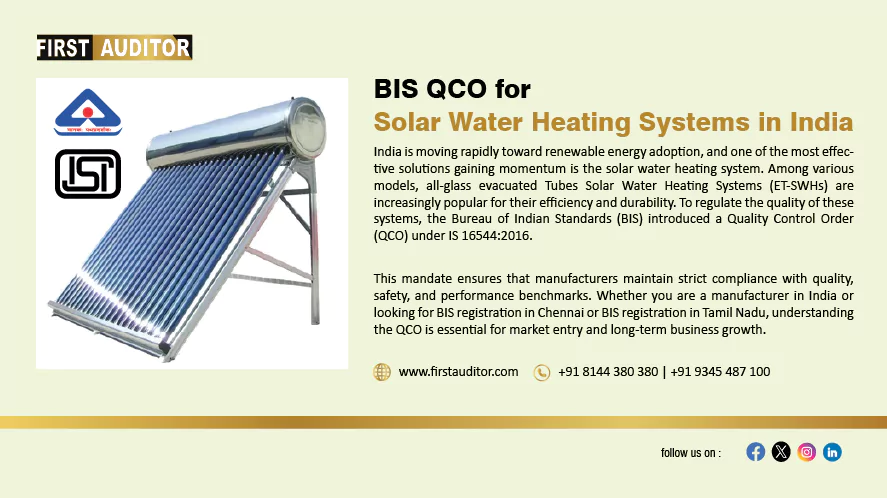
India is moving rapidly toward renewable energy adoption, and one of the most effective solutions gaining momentum is the solar water heating system. Among various models, all-glass evacuated Tubes Solar Water Heating Systems (ET-SWHs) are increasingly popular for their efficiency and durability. To regulate the quality of these systems, the Bureau of Indian Standards (BIS) introduced a Quality Control Order (QCO) under IS 16544:2016.
This mandate ensures that manufacturers maintain strict compliance with quality, safety, and performance benchmarks. Whether you are a manufacturer in India or looking for BIS registration in Chennai or BIS registration in Tamil Nadu, understanding the QCO is essential for market entry and long-term business growth.
What is BIS QCO for Solar Water Heating Systems?
The BIS QCO is a mandatory regulation under the Solar Thermal Systems, Devices and Components (Quality Control) Order, which requires all manufacturers of all-glass evacuated Tube Solar Water Heating Systems to obtain certification as per IS 16544:2016.
This certification guarantees that solar water heating systems comply with national standards, focusing on:
- Thermal efficiency
- Material strength and durability
- Safety features
- Sustainability and energy performance
The ultimate goal is to eliminate substandard products from the market while boosting consumer trust in renewable energy systems.
Significance of BIS Certification for Solar Water Heating Systems
For manufacturers, BIS registration in Tamil Nadu or anywhere in India is not just a compliance requirement—it is a business enabler. Here’s why:
1. Quality and Reliability
Certified systems undergo strict testing for durability, pressure resistance, and efficiency, ensuring consistent product performance.
2. Consumer Safety
BIS-certified systems minimize risks of overheating, leakage, or failure, giving consumers peace of mind.
3. Legal Compliance
Selling uncertified products attracts penalties under the BIS Act, 2016, which may include fines or restrictions.
4. Business Growth
Government tenders and large projects demand BIS-certified systems, giving certified manufacturers a competitive edge.
5. Sustainability
The QCO aligns with India’s renewable energy goals by promoting efficient systems that reduce carbon emissions.
BIS Registration Process for Solar Water Heating Systems
Manufacturers must follow a defined BIS registration process to obtain certification under IS 16544:2016:
- Application Submission – Submit the application online with details of products, factory setup, and quality processes.
- Document Submission – Provide documents such as factory registration certificates, process flowcharts, raw material reports, and quality control plans.
- Factory Inspection – BIS officials conduct an on-site inspection of facilities to verify compliance.
- Product Testing – Samples are tested in BIS-approved labs for parameters like thermal efficiency and structural strength.
- Approval and Certification – Once compliance is verified, BIS issues the license allowing the ISI mark.
- Ongoing Compliance – Manufacturers must undergo audits and renew certification periodically.
For BIS registration in Chennai, manufacturers can connect with compliance consultants to simplify document filing, testing, and inspections.
Key Requirements for BIS Certification
To maintain compliance under IS 16544:2016, manufacturers must:
- Have a legally registered factory
- Implement a strict quality control plan
- Comply with efficiency and durability standards
- Undergo periodic audits by BIS
- Provide updated documentation and test reports on request
Timeline for BIS Certification
- Indian Manufacturers – Approx. 30 days after application and testing
- Foreign Manufacturers (FMCS) – Up to 180 days due to additional regulatory steps
What is BIS Registration?
BIS registration is the official approval granted by the Bureau of Indian Standards, ensuring that a product meets the quality and safety standards defined under Indian Standards (IS). For solar water heating systems, it certifies compliance with IS 16544:2016.
This registration is crucial for:
- Selling products legally in India
- Building trust with customers
- Participating in government and large-scale projects
If you are a manufacturer exploring BIS registration in Tamil Nadu, this certification is your entry ticket to wider markets.
BIS Registration Rules in India
The BIS registration rules in India are framed under the BIS Act, 2016, and include:
- Certain products are covered under mandatory certification schemes like the Compulsory Registration Scheme (CRS) or QCO.
- Manufacturers (domestic or foreign) must apply for certification before selling products in India.
- BIS conducts audits and testing to ensure ongoing compliance.
- Non-compliance may result in fines, penalties, or product bans.
For industries dealing in renewable energy, adhering to these rules is critical to avoid legal hurdles and build a sustainable market reputation.
Benefits of BIS Certification for Manufacturers
- Enhanced Credibility – Builds consumer and market trust.
- Government Opportunities – Opens access to tenders requiring ISI-marked products.
- Market Acceptance – Easier acceptance in both domestic and export markets.
- Competitive Advantage – Stand out from uncertified competitors.
- Consumer Satisfaction – Deliver reliable, efficient products.
- Sustainability – Promotes energy-efficient systems aligned with India’s green energy goals.
Conclusion
The BIS QCO for All Glass Evacuated Tubes Solar Water Heating Systems under IS 16544:2016 is a milestone regulation ensuring that India’s renewable energy market thrives on trust, quality, and sustainability.
For manufacturers, whether seeking BIS registration in Chennai or BIS registration in Tamil Nadu, compliance with BIS certification rules not only prevents legal issues but also boosts credibility, opens doors to government projects, and enhances consumer satisfaction.
Frequently Asked Questions
It was introduced to set clear safety, durability, and performance benchmarks for solar water heating systems.
Yes, manufacturers must obtain BIS certification to legally sell or import solar water heating systems in India.
Products undergo tests for thermal efficiency, pressure resistance, material durability, and long-term performance.